| [Index] |
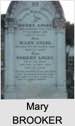
| Mary BROOKER (1812 - 1890) |


|

|
| b. 28 Nov 1812 at Hawkesbury District, New South Wales, Australia |
| m. (1) 14 Feb 1829 John HART ( - 1830) at Sydney, New South Wales, Australia |
| m. (2) 17 Nov 1833 Christopher LEDWIDGE (1799 - 1834) at Sydney, New South Wales, Australia |
| m. (3) 03 Sep 1834 Henry ANGEL (1791 - 1881) at Wollongong, New South Wales, Australia |
| d. 29 Sep 1890 at Lake Albert, New South Wales, Australia aged 77 |
| Near Relatives of Mary BROOKER (1812 - 1890) | ||||||
| Relationship | Person | Born | Birth Place | Died | Death Place | Age |
| Father in Law | William ANGEL | 22 Dec 1844 | Hale, Hampshire, England | |||
| Mother in Law | Mary SHERAN SHERING | 10 Mar 1830 | Hale, Hampshire, England | |||
| Father | Jonathan BROOKER | 1760 | Kent, UK | 14 Mar 1833 | Airds, New South Wales, Australia | 73 |
| Mother | Mary Anne WADE | 1777 | London, Middlesex, England | 17 Dec 1859 | Fairy Meadow, New South Wales, Australia | 82 |
| Self | Mary BROOKER | 28 Nov 1812 | Hawkesbury District, New South Wales, Australia | 29 Sep 1890 | Lake Albert, New South Wales, Australia | 77 |
| Husband | John HART | 1830 | Windsor, New South Wales, Australia | |||
| Husband | Christopher LEDWIDGE | 1799 | 05 Feb 1834 | Wollongong, New South Wales, Australia | 35 | |
| Husband | Henry ANGEL | abt 08 Jan 1791 | Woodgreen, Hampshire, England | 07 Dec 1881 | Lake Albert, New South Wales, Australia | 90 |
| Son | John Christopher LEDWIDGE | 26 Jul 1832 | Fairy Meadow, New South Wales, Australia | 01 Jul 1873 | Hay, New South Wales, Australia | 40 |
| Son | Christopher LEDWIDGE | 05 Feb 1834 | Fairy Meadow, New South Wales, Australia | 08 Aug 1869 | Balranald, New South Wales, Australia | 35 |
| Son | Henry ANGEL | 16 Nov 1836 | Fairy Meadow, New South Wales, Australia | 09 Jul 1924 | Wagga Wagga, New South Wales, Australia | 87 |
| Son | William ANGEL | 17 Oct 1838 | Fairy Meadow, New South Wales, Australia | 28 Oct 1891 | Newtown, New South Wales, Australia | 53 |
| Daughter | Keturah ANGEL | 05 Oct 1841 | Fairy Meadow, New South Wales, Australia | 22 Nov 1932 | Wagga Wagga, New South Wales, Australia | 91 |
| Son | Robert ANGEL | 05 Oct 1841 | Fairy Meadow, New South Wales, Australia | 19 May 1870 | Wagga Wagga, New South Wales, Australia | 28 |
| Son | Richard ANGEL | 19 Feb 1844 | Fairy Meadow, New South Wales, Australia | 16 Jun 1907 | Wagga Wagga, New South Wales, Australia | 63 |
| Daughter | Mary ANGEL | 10 Feb 1847 | Hay, New South Wales, Australia | 07 Jul 1932 | Kogarah, New South Wales, Australia | 85 |
| Daughter | Sarah M ANGEL | 10 Feb 1847 | Hay, New South Wales, Australia | |||
| Son | James ANGEL | 08 Mar 1850 | Hay, New South Wales, Australia | 05 Jun 1926 | Wagga Wagga, New South Wales, Australia | 76 |
| Son | Edward Jonathon ANGEL | 13 Jun 1852 | Hay, New South Wales, Australia | 08 Nov 1934 | Lake Albert, New South Wales, Australia | 82 |
| Son | Samuel ANGEL | 18 Feb 1853 | Campbelltown, New South Wales, Australia | 21 Apr 1938 | Wagga Wagga, New South Wales, Australia | 85 |
| Sister | Sarah WADE | 27 Sep 1793 | Norfolk Island | 05 Jul 1887 | 93 | |
| Brother | William James WADE BROOKER | 10 Dec 1796 | Norfolk Island | 09 Oct 1885 | Lake Albert, New South Wales, Australia | 88 |
| Brother | John BROOKER | 24 Jun 1809 | Windsor, New South Wales, Australia | 07 Dec 1886 | Kangaloon, New South Wales, Australia | 77 |
| Sister | Elizabeth BROOKER | 07 Dec 1810 | Hawkesbury District, New South Wales, Australia | |||
| Brother | James BROOKER | 30 May 1814 | Airds, New South Wales, Australia | 15 Mar 1880 | Fairy Meadow, New South Wales, Australia | 65 |
| Half Brother | Edward BROOKER HARRIGAN | 20 Aug 1803 | Sydney, New South Wales, Australia | 09 Jul 1891 | Fairy Meadow, New South Wales, Australia | 87 |
| Daughter in Law | Julia AHERN | 07 Feb 1833 | 01 Apr 1918 | 85 | ||
| Daughter in Law | Margaret Ann HERRICK | 25 Sep 1833 | 06 Aug 1932 | 98 | ||
| Daughter in Law | Emma TERRY | 23 Aug 1843 | Campbelltown, New South Wales, Australia | 12 Jan 1867 | Hay, New South Wales, Australia | 23 |
| Daughter in Law | Frances Eleanor Jane CORNISH | 1850 | Hay, New South Wales, Australia | 17 Apr 1927 | Wagga Wagga, New South Wales, Australia | 77 |
| Daughter in Law | Sarah Mary HARRIS | 29 Jul 1849 | Australia | 04 Jul 1935 | Sydney, New South Wales, Australia | 85 |
| Son in Law | John HURST | 06 Apr 1836 | Laughton, Leicestershire, England | 14 May 1922 | Wagga Wagga, New South Wales, Australia | 86 |
| Daughter in Law | Sarah BOYTON | 01 Jan 1846 | Australia | 17 Mar 1917 | Ashfield, New South Wales, Australia | 71 |
| Son in Law | Henry HARRIS | abt 1824 | 1907 | 83 | ||
| Daughter in Law | Eva FOOTE | |||||
| Daughter in Law | Eliza Jane BOYTON | 01 Jan 1856 | Campbelltown, New South Wales, Australia | 28 Mar 1912 | Wagga Wagga, New South Wales, Australia | 56 |
| Daughter in Law | Elizabeth BROOKER | 17 Aug 1857 | Campbelltown, New South Wales, Australia | 30 Nov 1904 | Wagga Wagga, New South Wales, Australia | 47 |
| Daughter in Law | Ellen Maria POWER | 08 Mar 1864 | Wagga Wagga, New South Wales, Australia | 14 Apr 1930 | Wagga Wagga, New South Wales, Australia | 66 |
| Daughter in Law | Emma Ann POWER | 27 Oct 1857 | 28 May 1946 | 88 | ||
| Grandson | Albert Terry Australia ANGEL | 03 Sep 1864 | Wagga Wagga, New South Wales, Australia | 14 Jan 1867 | Hay, New South Wales, Australia | 2 |
| Granddaughter | Christina Mary Beatrice ANGEL | 13 Feb 1866 | Hay, New South Wales, Australia | |||
| Granddaughter | Henrietta May ANGEL | 18 Mar 1875 | Wagga Wagga, New South Wales, Australia | 1957 | 82 | |
| Grandson | Henry George William ANGEL | 1877 | Wagga Wagga, New South Wales, Australia | 1941 | Parramatta, New South Wales, Australia | 64 |
| Granddaughter | Edith Maud ANGEL | 1879 | Wagga Wagga, New South Wales, Australia | |||
| Grandson | Lewis Arthur H ANGEL | 15 Feb 1881 | Wagga Wagga, New South Wales, Australia | 1953 | 72 | |
| Grandson | Walter Edgar ANGEL | 15 Feb 1881 | Wagga Wagga, New South Wales, Australia | |||
| Granddaughter | Ethel Ann Victoria ANGEL | 1882 | Wollongong, New South Wales, Australia | |||
| Grandson | Frederick Norman ANGEL | 19 Jan 1884 | Wagga Wagga, New South Wales, Australia | 1963 | 79 | |
| Grandson | Charles Ernest ANGEL | 21 Dec 1885 | Wagga Wagga, New South Wales, Australia | |||
| Granddaughter | Daisy Edith Maud ANGEL | 1887 | Wagga Wagga, New South Wales, Australia | |||
| Grandson | Sidney Percival ANGEL | 23 Feb 1890 | Wagga Wagga, New South Wales, Australia | |||
| Granddaughter | Alma Greta ANGEL | 14 Jul 1892 | Wagga Wagga, New South Wales, Australia | |||
| Granddaughter | Mary Jane HURST | 14 Apr 1861 | Wagga Wagga, New South Wales, Australia | 09 Feb 1954 | Wagga Wagga, New South Wales, Australia | 92 |
| Grandson | Henry HURST | 02 Feb 1863 | Balranald, New South Wales, Australia | 28 Nov 1906 | Wagga Wagga, New South Wales, Australia | 43 |
| Grandson | Charles George HURST | 04 Jun 1865 | Oura, New South Wales, Australia | 30 Sep 1924 | Wagga Wagga, New South Wales, Australia | 59 |
| Grandson | Robert John HURST | 22 Aug 1867 | Oura, New South Wales, Australia | 17 Nov 1960 | Wagga Wagga, New South Wales, Australia | 93 |
| Grandson | George HURST | 05 Sep 1869 | Oura, New South Wales, Australia | 31 Mar 1929 | Narrandera, New South Wales, Australia | 59 |
| Grandson | Albert HURST | 20 Aug 1872 | Oura, New South Wales, Australia | 29 Sep 1959 | Wagga Wagga, New South Wales, Australia | 87 |
| Grandson | Arthur HURST | 28 Jul 1874 | Oura, New South Wales, Australia | 02 Feb 1968 | Wagga Wagga, New South Wales, Australia | 93 |
| Grandson | Walter James HURST | 24 Dec 1876 | Oura, New South Wales, Australia | 03 Jun 1934 | Wagga Wagga, New South Wales, Australia | 57 |
| Granddaughter | Eliza Alice HURST | 23 Apr 1879 | Oura, New South Wales, Australia | 11 Dec 1936 | Wagga Wagga, New South Wales, Australia | 57 |
| Granddaughter | Ada May HURST | 11 Oct 1881 | Oura, New South Wales, Australia | |||
| Granddaughter | Maude Elizabeth HURST | 08 Jun 1885 | Oura, New South Wales, Australia | 28 Oct 1961 | 76 | |
| Grandson | Frederick William HURST | 04 Jun 1888 | Oura, New South Wales, Australia | |||
| Granddaughter | Emma ANGEL | 06 Jan 1867 | Lake Albert, New South Wales, Australia | 15 Aug 1950 | 83 | |
| Granddaughter | Ada ANGEL | 30 Jun 1868 | Nangus, New South Wales, Australia | 19 Nov 1952 | Wagga Wagga, New South Wales, Australia | 84 |
| Granddaughter | Sarah ANGEL | 29 Jul 1871 | Wagga Wagga, New South Wales, Australia | 18 Jan 1964 | Culcairn, New South Wales, Australia | 92 |
| Grandson | Robert Henry ANGEL | 30 Nov 1873 | Nangus, New South Wales, Australia | 11 Mar 1934 | Temora, New South Wales, Australia | 60 |
| Grandson | Herbert James ANGEL | 22 Aug 1874 | Wagga Wagga, New South Wales, Australia | 04 Jan 1950 | Temora, New South Wales, Australia | 75 |
| Grandson | Alfred Richard ANGEL | 29 Oct 1876 | Nangus, New South Wales, Australia | 22 Aug 1919 | Burwood, New South Wales, Australia | 42 |
| Grandson | Albert Charles 'Cap' ANGEL | 24 Aug 1878 | Lake Albert, New South Wales, Australia | 06 Nov 1939 | Wagga Wagga, New South Wales, Australia | 61 |
| Grandson | Arthur Edward ANGEL | 28 Mar 1880 | Nangus, New South Wales, Australia | 1958 | 78 | |
| Granddaughter | Eliza ANGEL | 14 Mar 1882 | Nangus, New South Wales, Australia | 28 Aug 1962 | Wagga Wagga, New South Wales, Australia | 80 |
| Grandson | Walter Ernest ANGEL | 28 Jan 1884 | Nangus, New South Wales, Australia | 1953 | 69 | |
| Granddaughter | Florrie ANGEL | 09 Jan 1886 | Gundagai, New South Wales, Australia | 17 Oct 1938 | 52 | |
| Granddaughter | Harlow ANGEL | 02 May 1888 | Lake Albert, New South Wales, Australia | 10 Jul 1888 | Wagga Wagga, New South Wales, Australia | 0 |
| Granddaughter | Olive ANGEL | 02 May 1888 | Lake Albert, New South Wales, Australia | 05 May 1888 | Lake Albert, New South Wales, Australia | 0 |
| Grandson | Ridley Amos ANGEL | 08 Mar 1890 | New South Wales, Australia | 06 Jul 1976 | Sutherland, New South Wales, Australia | 86 |
| Grandson | Allen Oswald ANGEL | 1892 | Lake Albert, New South Wales, Australia | 28 Sep 1980 | New South Wales, Australia | 88 |
| Grandson | Edgar Roy ANGEL | 25 Jul 1895 | Lake Albert, New South Wales, Australia | 29 Jul 1923 | Auburn, New South Wales, Australia | 28 |
| Granddaughter | Rebecca May ANGEL | 18 Sep 1876 | Wagga Wagga, New South Wales, Australia | 01 Feb 1920 | Wagga Wagga, New South Wales, Australia | 43 |
| Grandson | Stanley Edward ANGEL | 1881 | Wagga Wagga, New South Wales, Australia | |||
| Grandson | Leslie James ANGEL | 16 Feb 1883 | Lake Albert, New South Wales, Australia | 07 Nov 1956 | Wagga Wagga, New South Wales, Australia | 73 |
| Grandson | Walter Edwin ANGEL | 1885 | Wagga Wagga, New South Wales, Australia | |||
| Granddaughter | Myrtle Evelyn Blanche ANGEL | 1886 | Wagga Wagga, New South Wales, Australia | |||
| Grandson | Harvey Edgar ANGEL | 1888 | Wagga Wagga, New South Wales, Australia | |||
| Granddaughter | Muriel E ANGEL | 1890 | Wagga Wagga, New South Wales, Australia | |||
| Grandson | Horace Edmond ANGEL | 1892 | Wagga Wagga, New South Wales, Australia | |||
| Granddaughter | Ivy ANGEL | 1895 | Wagga Wagga, New South Wales, Australia | |||
| Granddaughter | Eva ANGEL | 1897 | Wagga Wagga, New South Wales, Australia | |||
| Grandson | Harold B ANGEL | 1897 | Wagga Wagga, New South Wales, Australia | |||
| Granddaughter | Mary Blanche ANGEL | 1877 | Wagga Wagga, New South Wales, Australia | |||
| Grandson | Albert Charles ANGEL | 1880 | Wagga Wagga, New South Wales, Australia | |||
| Granddaughter | Clarice ANGEL | 1882 | Wagga Wagga, New South Wales, Australia | |||
| Grandson | Samuel ANGEL | 1885 | Wagga Wagga, New South Wales, Australia | 01 Mar 1950 | Mangoplah, New South Wales, Australia | 65 |
| Granddaughter | Amy Grace ANGEL | 1888 | Wagga Wagga, New South Wales, Australia | 09 Apr 1922 | Wagga Wagga, New South Wales, Australia | 34 |
| Granddaughter | Linda ANGEL | 1891 | Wagga Wagga, New South Wales, Australia | 25 Jul 1916 | Corowa, New South Wales, Australia | 25 |
| Granddaughter | Olive Bertha ANGEL | 1894 | Wagga Wagga, New South Wales, Australia | |||
| Niece | Mary RAY | 16 Sep 1809 | 1837 | 28 | ||
| Niece | Sophia RAY | 28 May 1812 | Campbelltown, New South Wales, Australia | 1877 | Wagga Wagga, New South Wales, Australia | 65 |
| Nephew | William RAY | 07 Dec 1814 | 30 May 1885 | Marrickville, Sydney, Australia | 70 | |
| Nephew | John RAY | 12 Oct 1817 | Campbelltown, New South Wales, Australia | 10 Sep 1859 | 41 | |
| Niece | Maria RAY | 16 May 1822 | 22 Apr 1924 | Sydney, New South Wales, Australia | 101 | |
| Nephew | Nathaniel BOON | 14 Sep 1825 | 11 Feb 1911 | Gundagai, New South Wales, Australia | 85 | |
| Niece | Margaret BOON | 17 Sep 1826 | 09 Jul 1904 | 77 | ||
| Nephew | Thomas BOON | 12 Aug 1828 | ||||
| Nephew | James BOON | 20 Nov 1830 | ||||
| Nephew | Jonathan BOON | 20 Nov 1830 | 15 May 1901 | 70 | ||
| Nephew | Nicholas BOON | 20 Nov 1830 | 18 Nov 1899 | 68 | ||
| Niece | Sarah Ann BOON | 02 Jun 1832 | 12 Oct 1854 | 22 | ||
| Nephew | Daniel BOON | 25 Nov 1852 | 19 Jul 1876 | 23 | ||
| Niece | Mary Ann BROOKER | 24 Mar 1821 | Campbelltown, New South Wales, Australia | 09 Jan 1863 | Wagga Wagga, New South Wales, Australia | 41 |
| Niece | Sarah Elizabeth BROOKER | 20 Mar 1823 | Campbelltown, New South Wales, Australia | 23 Nov 1890 | Wagga Wagga, New South Wales, Australia | 67 |
| Nephew | William BROOKER | 26 Dec 1824 | 09 Jun 1892 | 67 | ||
| Nephew | Jonathan BROOKER | 16 Jun 1827 | Campbelltown, New South Wales, Australia | 14 Feb 1829 | Campbelltown, New South Wales, Australia | 1 |
| Niece | Elizabeth BROOKER | 11 Mar 1830 | 08 May 1905 | 75 | ||
| Nephew | Jonathon BROOKER | 19 Jul 1832 | New South Wales, Australia | 03 Jun 1888 | Wagga Wagga, New South Wales, Australia | 55 |
| Nephew | James BROOKER | 16 Oct 1834 | Campbelltown, New South Wales, Australia | 17 Sep 1907 | Wagga Wagga, New South Wales, Australia | 72 |
| Niece | Sophia Jane BROOKER | 19 Jul 1838 | Campbelltown, New South Wales, Australia | 1916 | Redfern, New South Wales, Australia | 78 |
| Nephew | Joseph Henry BROOKER | 27 Feb 1840 | Campbelltown, New South Wales, Australia | 21 Dec 1840 | Campbelltown, New South Wales, Australia | 0 |
| Niece | Eliza BROOKER | 21 Feb 1843 | 20 May 1877 | 34 | ||
| Niece | Mary BROOKER | 18 Dec 1848 | 20 Jul 1931 | Kangaloon, New South Wales, Australia | 82 | |
| Nephew | Jonathan BROOKER | 03 Dec 1849 | Wollongong, New South Wales, Australia | 17 Jun 1906 | Kangaloon, New South Wales, Australia | 56 |
| Nephew | William BROOKER | 24 May 1851 | Charcoal Creek, New South Wales, Australia | 05 Apr 1935 | Kangaloon, New South Wales, Australia | 83 |
| Nephew | Murdo BROOKER | 13 May 1853 | Charcoal Creek, New South Wales, Australia | 29 Jun 1913 | Robertson, New South Wales, Australia | 60 |
| Niece | Sophia LOWE | 14 Apr 1828 | Campbelltown, New South Wales, Australia | 29 Mar 1893 | Wollongong, New South Wales, Australia | 64 |
| Niece | Louisa Willison BROOKER | 1853 | 1854 | 1 | ||
| Niece | Rosina BROOKER | 1855 | Tarrawanna, New South Wales, Australia | 20 Jan 1944 | Corrimal, New South Wales, Australia | 89 |
| Nephew | James Albert BROOKER | 22 May 1858 | 27 Oct 1939 | 81 | ||
| Niece | Mary Louisa BROOKER | 15 Mar 1860 | 02 Nov 1937 | 77 | ||
| Nephew | William Willison BROOKER | 03 Nov 1862 | Fairy Meadow, New South Wales, Australia | 19 Mar 1863 | Fairy Meadow, New South Wales, Australia | 0 |
| Niece | Mary Anne HARRIGAN | 1835 | 07 Aug 1870 | 35 | ||
| Niece | Elizabeth HARRIGAN | 10 Jun 1837 | 20 Dec 1915 | 78 | ||
| Nephew | James Edward HARRIGAN | 28 May 1839 | 12 May 1929 | 89 | ||
| Niece | Sarah Jane HARRIGAN | 1855 | 28 Oct 1893 | 38 | ||
| Nephew | William HARRIGAN | 22 Dec 1857 | 04 Sep 1948 | 90 | ||
| Niece | Louisa Emily HARRIGAN | 22 Mar 1860 | 17 Jan 1889 | 28 | ||
| Niece | Alice Clara HARRIGAN | 05 Aug 1863 | 17 Jan 1956 | 92 | ||
| Brother in Law | William RAY | abt 1759 | 17 Oct 1835 | 76 | ||
| Brother in Law | Nathaniel BOON | 1792 | 18 Feb 1839 | 47 | ||
| Sister in Law | Sophia MITTON | 24 May 1801 | Parramatta, New South Wales, Australia | 17 Jan 1892 | Lake Albert, New South Wales, Australia | 90 |
| Sister in Law | Janet MCKENZIE | abt 1809 | 04 May 1901 | Robertson, New South Wales, Australia | 92 | |
| Brother in Law | Daniel LOWE | 07 Oct 1810 | ||||
| Sister in Law | Elizabeth Willison WOOD | abt 1821 | Cork, Co Cork, Ireland | 03 Jan 1916 | Gosford, New South Wales, Australia | 95 |
| Sister in Law | Mary WEBBER | abt 1797 | Guernsey, Channel Islands, UK | 07 Feb 1854 | Dapto, New South Wales, Australia | 57 |
| Sister in Law | Jane Willison WOOD | 1820 | Cork, Co Cork, Ireland | 1916 | Tarrawanna, New South Wales, Australia | 96 |
| Events in Mary BROOKER (1812 - 1890)'s life | |||||
| Date | Age | Event | Place | Notes | Src |
| 28 Nov 1812 | Mary BROOKER was born | Hawkesbury District, New South Wales, Australia | 71 | ||
| 14 Feb 1829 | 16 | Married John HART | Sydney, New South Wales, Australia | 71 | |
| 1830 | 18 | Death of husband John HART | Windsor, New South Wales, Australia | ||
| 26 Jul 1832 | 19 | Birth of son John Christopher LEDWIDGE | Fairy Meadow, New South Wales, Australia | ||
| 14 Mar 1833 | 20 | Death of father Jonathan BROOKER (aged 73) | Airds, New South Wales, Australia | ||
| 17 Nov 1833 | 20 | Married Christopher LEDWIDGE (aged 34) | Sydney, New South Wales, Australia | 71 | |
| 05 Feb 1834 | 21 | Birth of son Christopher LEDWIDGE | Fairy Meadow, New South Wales, Australia | ||
| 05 Feb 1834 | 21 | Death of husband Christopher LEDWIDGE (aged 35) | Wollongong, New South Wales, Australia | ||
| 03 Sep 1834 | 21 | Married Henry ANGEL (aged 43) | Wollongong, New South Wales, Australia | 71 | |
| 16 Nov 1836 | 23 | Birth of son Henry ANGEL | Fairy Meadow, New South Wales, Australia | 1065/1836 V18361065 20 | 71 |
| 17 Oct 1838 | 25 | Birth of son William ANGEL | Fairy Meadow, New South Wales, Australia | 1109/1838 V18381109 22 | 71 |
| 05 Oct 1841 | 28 | Birth of daughter Keturah ANGEL | Fairy Meadow, New South Wales, Australia | 1516/1841 V18411516 25A | 71 |
| 05 Oct 1841 | 28 | Birth of son Robert ANGEL | Fairy Meadow, New South Wales, Australia | 1517/1841 V18411517 25A | 71 |
| 19 Feb 1844 | 31 | Birth of son Richard ANGEL | Fairy Meadow, New South Wales, Australia | 1867/1844 | 71 |
| 10 Feb 1847 | 34 | Birth of daughter Mary ANGEL | Hay, New South Wales, Australia | 946/1848 | 71 |
| 10 Feb 1847 | 34 | Birth of daughter Sarah M ANGEL | Hay, New South Wales, Australia | ||
| 08 Mar 1850 | 37 | Birth of son James ANGEL | Hay, New South Wales, Australia | 947/1848 | 71 |
| 13 Jun 1852 | 39 | Birth of son Edward Jonathon ANGEL | Hay, New South Wales, Australia | 71 | |
| 18 Feb 1853 | 40 | Birth of son Samuel ANGEL | Campbelltown, New South Wales, Australia | 4242/1853 | 71 |
| 17 Dec 1859 | 47 | Death of mother Mary Anne WADE (aged 82) | Fairy Meadow, New South Wales, Australia | ||
| 08 Aug 1869 | 56 | Death of son Christopher LEDWIDGE (aged 35) | Balranald, New South Wales, Australia | Note 1 | |
| 19 May 1870 | 57 | Death of son Robert ANGEL (aged 28) | Wagga Wagga, New South Wales, Australia | 71 | |
| 01 Jul 1873 | 60 | Death of son John Christopher LEDWIDGE (aged 40) | Hay, New South Wales, Australia | ||
| 07 Dec 1881 | 69 | Death of husband Henry ANGEL (aged 90) | Lake Albert, New South Wales, Australia | 71 | |
| 29 Sep 1890 | 77 | Mary BROOKER died | Lake Albert, New South Wales, Australia | 71 | |
| Note 1: 2675/1869 aged 35 HAY died BALRANALD |
| Personal Notes: |
| Mary Brooker was the third child born to Mary Wade and Jonathan Brooker in New South Wales. She was born on 28th November, 1812, in the Hawkesbury District where her father, freed by servitude on Norfolk Island, was supporting his family possibly as a carpenter. While Mary was a very small child the family moved to their new home at Airds (Campbelltown). When 11 years old, Mary shared with her family the tragic experience of being rendered destitute by a severe bushfire. By 1828 we find the family established on the Illawarra, near Corrimal. Jonathan’s household consisted of his wife Mary, their children John, Mary and James, and Edward Harrigan, referred to as Edward Brooker. Shortly after her 16th birthday, Mary Brooker married John Hart on 14th February 1829. Father Therry, a Roman Catholic priest, performed the ceremony and the marriage was registered at Liverpool. John Hart, who had arrived a free man on the Earl St Vincent, was about 29 years of age. This marriage was short lived and without issue as John Hart soon died. Mary’s second marriage, to Christopher Ledwidge, was also conducted by Father Therry on 1 7th November, 1833. Ledwidge had arrived on the transport Isobella in 1822 to serve a term of 7 years transportation, Christopher was listed as a Catholic labourer, assigned to Charles Tunstall, a bricklayer of Lower Minto. In 1824 he was sent to Port Macquarie as a punishment for attempting to rob a cart. He returned to Lower Minto in 1827, gained his freedom the next year, and settled at Fairy Meadow in the Illawarra District. It was here that he met the young widow Mary Hart, daughter of Jonathan Brooker and Mary Wade. She bore him a son, John, in 1832, and they married on 17th November, 1833. The following year, on the very day of Christopher’s death, a second son was born and named Christopher. This meant that within four years, and still only 21, Mary was twice widowed and the mother of two boys. These circumstances probably explain why, less than a year later, Mary married for a third time. The groom was Henry Angel, a farmer of Fairy Meadow. The marriage was by Banns with the consent of the Governor. and took place on 3rd January, 1834, in the Church of England School House in Wollongong. Henry Angel was a very colourful character. He was as born in Salisbury. England, in 1791, and had worked on the land from an early age, becoming proficient in the skills of farming. At the age of 26 a brush with the law earned him a conviction and he was sentenced to transportation for life. Exact circumstances of his crime remain a mystery but according to family Folk-lore Henry may have been the innocent victim of a miscarriage of justice. This version that at the age of 17 he purchased a pair of bloodstained boots from a stranger for one shilling and was subsequently charged with the murder of the owner of the boots. Since could not produce evidence to the contrary, he was tried, convicted and sentenced to be hanged, the sentence being commuted to transportation for life. The second explanation for Henry’s transportation rests on more reliable documented evidence. An extract from a sworn statement in the Public Records Office, London states that Henry Angel and an accomplice were tried on 18th March 1817 for highway robbery. Henry was found guilty and sentenced to life imprisonment. He arrived in New South aboard the transport Neptune on 9th May 1818 to serve his sentence. Henry was described as having a ruddy complexion, 5′ 2 ½” tall, brown hair and hazel eyes. Sometime after his arrival Henry was assigned to William Cox, a considerable land holder, best remembered for his role in the construction of the first road over Blue Mountains in 1815. It appears that Cox recommended Henry Angel to Hamilton Hume was preparing for his expedition with Hovell, to Port Phillip. Subsequently Angel was assigned to Hume for the expedition and a close bond of friendship developed between these two men. As the overland journey continued, Angel proved of great value in difficult situations. On reaching the Murray, Angel became the first white man to swim across the river. He did do to get a line across in order to facilitate the crossing over of equipment and stores. On returning to Sydney at the completion of the journey, Hume received a land grant at Shoalhaven. Henry Angel’s part was recognised by the granting of a ticketofleave on Hume’s recommendation. This was granted on 5th July 1825 for the district of Appin by special order of the Governor and was later altered to cover the District of Illawarra. Hume also recognised Angel’s contribution by making him a gift of two good quality bullocks and a watch. This watch was in the possession of one of daughters until fairly recently. Its immediate location is not at present known. Angel lived in the Corrimal area, but on the 14th January 1828, his ticketofleave was revoked on a charge of harbouring a notorious cattle stealer in his house, and with having some connection with the gang. He was returned to Government Service and in the 1828 Census taken in November, he is listed as Protestant, aged 36 years and living in convict barracks, Liverpool. At about this time, Sturt invited Hume to accompany him on his first expedition to trace headwaters of the Macquarie River. Together, Sturt and Hume selected a small party soldiers and convicts to assist them on the journey, among whom Henry Angel was included. This expedition reached the Darling River before returning to Sydney. On 22nd February 1832, Henry Angel’s ticketofleave was restored in recognition of his assistance in the capture of a bushranger named Patrick Burke, notorious for his activities on the lonely road between Appin and Illawarra. Thereafter he was registered at the P.O. Wollongong as a resident of Fairy Meadow and 1834 he married Mary Ledwidge (nee Brooker). It is interesting to note that Henry did not get his conditional pardon until 1st October 1841 so he was still a ticketofleave convict at the time of his marriage. After this marriage, Henry and Mary lived in a pitsawn timber shed on the Angel farm, together .With Mary’s two young sons, John and Christopher Ledwidge. The two small boys were soon joined by some Angel children. There were Henry (1836), William (1838) and twins, Keturah and Robert (1841). The Ledwidge boys and Robert Angel in due time attended the local school, a simple slab and bark building about one mile south of Angel’s Bridge which spanned Towradgi Creek running through the Angel farm. From time to time the boys would arrive at the school with the two bullocks Hume had given to Angel, in order to carry firewood for the teacher. The bullocks carried the double H (HH) brand of Hamilton Hume and were always of great interest. Angel’s English farming upbringing, together with his bush experience in Australia, stood him in good stead as a pioneer settler. James Gormley recalls “I had frequent opportunities of seeing how Angel cultivated his land and managed his working horses and bullocks and the plan he then adopted 1 have not since excelled … (he) did the work slowly and carefully, evidently on a well defined plan.” A good description of the area at about the time was recorded in 1846 by a retired army colonel, Godfrey Mundy:The pretty village of Fairy Meadow, close to Wollongong, separated by a ridge of highish land from the seaboard, backed by the mountain range, with a meandering stream of fresh water running through the flat; settlers’ houses perched on the hills, bark huts overgrown with passion flowers, vines, ivy or gourds; fields of growing wheat or maize with its tall, green flags and yellow plumes; rude barns at the corners of the enclosures, where the cheerful sound of the flail reaches the traveller’s ear.” A prominent feature on the range behind Fairy Meadow is called Broker’s Nose. (Broker was the spelling used for Brooker in many old documents). This feature resembles the outline of a human face profile, and is so named as it is a part of the range close to Brooker land. By the eighteen fifties the descendants of Mary Wade (Mary Angel’s mother and an early resident) were leaving permanent place names throughout the district. These include street names such as Brokers Road, Harrigan Street, etc, and features such as Angels Bridge and Broker’s Nose. During the eighteen thirties, Henry appeared to be interested in various parcels of land. In 1839 he was unsuccessful in purchasing land at Garie but later purchased 50 acres on the Cataract River near Wollongong. In 1841 he received a conditional pardon from the Governor, Sir George Gipps, to take effect from 28th December 1841. He was now a free man, but unable to return to England. Two of Mary Angel’s nephews, John and Edward Ray, journeyed southwest into the Riverina in 1840. Their assessment of the land available in the. Hay district was enough to encourage Henry Angel to move his young family 450 miles to the area in 1844. Originally Angel settled on the opposite side of the river to the Rays, believing the land to be available. He built a house there on the south bank, called ‘Yangunjular’ after the name of the local aboriginal tribe. The Commissioner for Crown Lands changed the name to Wardry, which is not an aboriginal name. It finally reverted to Uardry, a native name meaning yellow box tree and to this day the station retains the name Uardry. Another son of Mary Wade, Edward Harrigan, went to the area in 1849 but he preferred the Illawarra and returned there in 1853. While at Uardry four sons and a daughter were added to, the Angel family between 1844 and 1853. Uardry was an extensive holding used by Ray and Angel as a cattle and sheep run. The N.S.W. Gazette for 1866 states, “Uardry” station(Lachlan District) occupiers Ray and Angel; area 32,000 acres, grazing capability, 900 head of cattle. Crown charges £53/13/9. It is recorded that Angel and some of his sons made trips to Sydney from time to time. On one such trip in 1846, Henry Angel junior remembers that he and his father carried a ton of cheese to Sydney which they sold, bringing back provisions. The team used consisted of a horse in the shafts of a dray and four bullocks leading. The round trip took three months. On his return, Henry Angel presented the local Aboriginal chief with a brass plate he had obtained in Sydney, inscribed to Jacky, King of Yangunjular. It should be realised that while at Uardry the Angels were living a frontier existence. The Angels enjoyed a good friendly relationship with the local aborigines, but among themselves the native tribes observed their traditional customs, including conflict. Murder was not unknown among them, and Henry Angel himself witnessed at least one fight to the death between two rival chiefs. Henry’s wife Mary relates a story of an aboriginal visitor sampling chillies from her kitchen table. “He got the surprise of his life”,said Mary, “shouting, ‘Pattacollu, Pattacoliu’, meaning give me water. The white population of Uardry was comparatively large with both the Ray and Angel families there. The Ledwidge boys became expert horsemen and worked as stockmen on the station. The trips to Sydney provided an opportunity to visit relations and family friends at Campbelltown and on the Illawarra. Such trips provided contact with school friends of the Ledwidges and Henry Angel junior. On one such trip in 1855, Christie Ledwidge married Margaret Ann Herrick, who came from a family connected by marriage to his cousin Edward Ray and his uncle, William Brooker. The same year John Ledwidge married Julia Ahern of Fairy Meadow who had attended the local school with him. John and Christie each had ten children and 26 and 54 grandchildren respectively. Consequently many Australians can trace their origins to these two brothers. Most of John’s descendants come through his seven daughters and do not carry the Ledwidge name, but Christopher’s descendants are mostly through his sons and this ensured the Ledwidge name still survives in the area. By 1859 the district had developed sufficiently for the establishment of a new township called Hay at Lang’s Crossing. The Ledwidge brothers left Uardry at this stage to try their luck as publicans in the new town. It was not long before John, who sadly missed his horses, purchased a new team and set up as a carrier. Christie continued as a publican of the Caledonian Hotel, Hay, and did well. In 1868 he left Hay to open the Currathool Hotel at Carrathool. He died the following year and his wife carried on the business. John gave up carrying and worked as a labourer until his death in 1873. One of Christie’s sons, John, became a pioneer of Swan Hill in 1876, arriving there on foot having walked from Hay. He has recorded a notable description of white settlement in the area at that time: The country at that time had not been opened up for closer settlement and was largely in the virgin state. As a contractor with a large number of men under me, 1 ran 28,000 acres of box timber on Lalbert Station, and about 20,000 acres on Springfield Station. Blacks roamed everywhere, and there was an encampment on the other side of the river, opposite the present pumping station. They were a tame lot however, and did not molest the white invaders. Wildlife abounded and there were any amount of emus and kangaroos. The rabbit population had reached alarming proportions and presented a major problem; they were so thick that at one time they actually blocked the Boga road when the coach was proceeding to Swan Hill. We killed thousands in Lake Boga alone. There was a great social spirit pervading the whole community. The greatest event of the year was the Oddfellows Ball, held in the new brick school. It was a wonderful affair and attended by all the people of the district. Tickets cost one pound ten shillings apiece but was worth every penny of it. What a feast we had! Plenty of suckling pig and turkey, in striking contrast to the suppers of today perhaps a piece of cake.” John’s wife, Annie, was employed as a cook at the Swan Hill Coffee Palace in Campbell Street and afterwards accompanied him on his contracts, cooking for the men and camping under bullock waggons. In 1864 (?) Henry Angel sold his rights to at least part of Uardry and purchased a property called Spring Vale near Lake Albert, a few miles south of Wagga. He was now in his seventies and remained there until his death, aged 91, in 1881. Perusal of his Will indicates that by the time of his death, Angel was a man of considerable wealth, a rather remarkable achievement for a former convict transported to the colony in 1818 to serve out a life sentence. It was entirely due to his own efforts that he had acquired such wealth and he did not wish to see it frittered away. His Will contains a firm direction to his beneficiaries as follows: “I wish it to be understood by all my dear children that as 1 have worked hard and long to gain the property which 1 now possess and which 1 hereby devise and bequeath in their favour, so 1 earnestly desire they will not, unless for very good reasons, sell or mortgage the said properties, but 1 do not forbid them so doing.” Mary Angel survived Henry by nine years. She died on 29th September 1890 at Lake Albert, aged 78 years, and was buried beside Henry in the Church of England section of Wagga Wagga Cemetery. She was survived by six sons and two daughters, three sons being deceased. One of Mary’s descendants received considerable acclaim in 1941. Corporal John Hurst Edmondson was awarded a V.C. posthumously. for bravery in action on the night of 1314th April 1941 at Tobruk. This V.C. medal was the first awarded to an Australian in the Second World War. |
| Source References: |
| 71. Type: Book, Abbr: Wagga Pioneers, Title: Pioneers of Wagga Wagga and District, Auth: Wagga Wagga & District Family History Society Inc, Publ: Wagga Wagga & District Family History Society Inc, Date: 2004, Locn: http://www.waggafamilyhistory.org.au/ |
| - Reference = 5 (Death) |
| - Reference = 5 (Marriage) |
| - Reference = 5 (Birth) |
| - Reference = 5 (Marriage) |
| - Reference = 5 (Marriage) |
| - Reference = 173 (Name, Notes) |
| 76. Type: Web Page, Abbr: Find a Grave, Title: Find A Grave, Locn: https://www.findagrave.com/ |
| - Reference = https://www.findagrave.com/memorial/138439799/mary-angel (Name, Notes) |
| 85. Type: Book, Abbr: Mary Wade to Us, Title: Mary Wade to Us, Auth: Mary Wade Family History Association, Publ: Mary Wade Family History Association, Date: 1986, Locn: https://www.marywadefamily.org/items/show/1 |
| - Reference = page 179++ (Name, Notes) |
| - Notes: Mary Brooker was the third child born to Mary Wade and Jonathan Brooker in New South Wales. She was born on 28th November, 1812, in the Hawkesbury District where her father, freed by servitude on Norfolk Island, was supporting his family - possibly as a carpenter. While Mary was a very small child the family moved to their new home at Airds (Campbelltown). When 11 years old, Mary shared with her family the tragic experience of being rendered destitute by a severe bushfire. By 1828 we find the family established on the Illawarra, near Corrimal. Jonathan’s household consisted of his wife Mary, their children John, Mary and James, and Edward Harrigan, referred to as Edward Brooker.
Shortly after her 16th birthday, Mary Brooker married John Hart on 14th February 1829. Father Therry, a Roman Catholic priest, performed the ceremony and the marriage was registered at Liverpool. John Hart, who had arrived a free man on the EarlSt Vincent, was about 29 years of age. This marriage was short lived and without issue as John Hart soon died. Mary's second marriage, to Christopher Ledwidge, was also conducted by Father Therry on 17th November, 1833. Ledwidge had arrived on the transport Isobella in 1822 to serve a term of 7 years transportation. Christopher was listed as a Catholic labourer, assigned to Charles Tunstall, a bricklayer of Lower Minto. In 1824 he was sent to Port Macquarie as a punishment for attempting to rob a cart. He returned to Lower Minto in 1827, gained his freedom the next year, and settled at Fairy Meadow in the Illawarra District. It was here that he met the young widow Mary Hart, daughter of Jonathan Brooker and Mary Wade. She bore him a son, John, in 1832, and they married on 17th November, 1833. The following year, on the very day of Christopher's death, a second son was born and named Christopher. This meant that within four years, and still only 21, Mary was twice widowed and the mother of two boys. These circumstances probably explain why, less than a year later, Mary married for a third time. The groom was Henry Angel, a farmer of Fairy Meadow. The marriage was by Banns with the consent of the Governor, and took place on 3rd January, 1834, in the Church of England School House in Wollongong. Henry Angel was a very colourful character. He was born in Salisbury, England, in 1791, and had worked on the land from an early age, becoming proficient in the skills of farming. At the age of 26 a brush with the law earned him a conviction and he was sentenced to transportation for life. Exact circumstances of his crime remain a mystery but according to family folk-lore, Henry may have been the innocent victim of a miscarriage of justice. This version holds that at the age of 17 he purchased a pair of blood-stained boots from a stranger for one shilling and was subsequently charged with the murder of the owner of the boots. Since Henry could not produce evidence to the contrary, he was tried, convicted and sentenced to be hanged, the sentence being commuted to transportation for life. The second explanation for Henry's transportation rests on more reliable documented evidence. An extract from a sworn statement in the Public Records Office, London, states that Henry Angel and an accomplice were tried on 18th March 1817 for highway robbery. Henry was found guilty and sentenced to life imprisonment. He arrived in New South Wales aboard the transport Neptune on 9th May 1818 to serve his sentence. Henry was described as having a ruddy complexion, 5'2½” tall, brown hair and hazel eyes. Sometime after his arrival Henry was assigned to William Cox, a considerable land holder, best remembered for his role in the construction of the first road over the Blue Mountains in 1815. It appears that Cox recommended Henry Angel to Hamilton Hume when Hume was preparing for his overland expedition with Hovell, to Port Phillip. Subsequently Angel was assigned to Hume for the expedition and a close bond of friendship developed between these two men. As the overland journey continued, Angel proved of great value in difficult situations. On reaching the Murray, Angel became the first white man to swim across the river. He did so to get a line across in order to facilitate the crossing over of equipment and stores. On returning to Sydney at the completion of the journey, Hume received a land grant on the Shoalhaven. Henry Angel's part was recognised by the granting of a ticket-of-leave on Hume's recommendation. This was granted on 5th Jul 1825 for the district of Appin by special order of the Governor and was later altered to cover the District of Illawarra. Hume also recognised Angel's contribution by making him a gift of two good quality bullocks and a watch. This watch was in the possession of one of his grand- daughters until fairly recently. Its immediate location is not at present known. Angel lived in the Corrimal area, but on 14th January 1828, his ticket-of-leave was revoked on a charge of harbouring a notorious cattle stealer in his house, and with having some connection with the gang. He was returned to Government Service and in the 1828 Census taken in November, he is listed as Protestant, aged 36 years and living in convict barracks, Liverpool. At about this time, Sturt invited Hume to accompany him on his first expedition to trace the head-waters of the Macquarie River. Together, Sturt and Hume selected a small party of soldiers and convicts to assist them on the journey, among whom Henry Angel was included. This expedition reached the Darling River before returning to Sydney. On 22nd February 1832, Henry Angel's ticket-of-leave was restored in recognition of his assistance in the capture of a bushranger named Patrick Burke, notorious for his activities on the lonely road between Appin and Illawarra. Thereafter he was registered at the P.O. Wollongong as a resident of Fairy Meadow and to 1834 he married Mary Ledwidge (nee Brooker). It is interesting to note that Henry did not get his conditional pardon until 1st October 1841 so he was still a ticket-of-leave convict at the time of his marriage. Alter this marriage, Henry and Mary lived in a pit-sawn timber shed on the Angel farm, together with Mary's two young sons, John and Christopher Ledwidge. The two small boys were soon joined by some Angel children. There were Henry (1836), William (1838) and twins, Keturah and Robert (1841). The Ledwidge boys and Robert Angel in due time attended the local school, a simple slab and bark building about one mile south of Angel's Bridge which spanned Towradgi Creek running through the Angel farm. From time to time the boys would arrive at the school with the two bullocks Hume had given to Angel, in order to carry firewood for the teacher. The bullocks carried the double H (HH) brand of Hamilton Hume and were always of great interest. Angel's English farming upbringing, together with his bush experience in Australia, stood him in good stead as a pioneer settler. James Gormley recalls "I had frequent opportunities of seeing how Angel cultivated his land and managed his working horses and bullocks and the plan he then adopted I have not since excelled . . . (he) did the work slowly and carefully, evidently on a well defined plan." A good description of the area at about the time was recorded in 1846 by a retired army colonel, Godfrey Mundy: "The pretty village of Fairy Meadow, close to Wollongong, separated by a ridge of highish land from the seaboard, backed by the mountain range, with a meandering stream of fresh water running through the flat; settlers' houses perched on the hills, bark huts overgrown with passion flowers, vines, ivy or gourds; fields of growing wheat or maize with its tall, green flags and yellow plumes; rude barns at the corners of the enclosures, where the cheerful sound of the flail reaches the traveller's ear." A prominent feature on the range behind Fairy Meadow is called Broker's Nose. (Broker was the spelling used for Brooker in many old documents). This feature resembles the outline of a human face profile, and is so named as it is a part of the range close to Brooker land. By the eighteen fifties the descendants of Mary Wade (Mary Angel's mother and an early resident) were leaving permanent place names throughout the district. These include street names such as Brokers Road, Harrigan Street, etc, and features such as Angels Bridge and Broker's Nose. During the eighteen thirties, Henry appeared to be interested in various parcels of land. In 1839 he was unsuccessful in purchasing land at Garie but later purchased 50 acres on the Cataract River near Wollongong. In 1841 he received a conditional pardon from the Governor, Sir George Gipps, to take effect from 28th December 1841. He was now a free man, but unable to return to England. Two of Mary Angel's nephews, John and Edward Ray, journeyed south-west into the Riverina in 1840. Their assessment of the land available in the Hay district was enough to encourage Henry Angel to move his young family 450 miles to the area in 1844. Originally Angel settled on the opposite side of the river to the Rays, believing the land to be available. He built a house there on the south bank, called 'Yangunjular' after the name of the local aboriginal tribe. The Commissioner for Crown lands changed the name to Wardry which is not an aboriginal name. It finally reverted to Uardry, a native name meaning yellow box tree and to this day the station retains the name Uardry. Another son of Mary Wade, Edward Harrigan, went to the area in 1849 but he preferred the Illawarra and returned there in 1853. While at Uardry four sons and a daughter were added to the Angel family between 1844 and 1853. Uardry was an extensive holding used by Ray and Angel as a cattle and sheep run. The N.S.W. Gazette for 1866 states, "Uardry station (Lachlan District) occupiers - Ray and Angel; area 32,000 acres, grazing capability, 900 head of cattle. Crown charges £53/13/9." It is recorded that Angel and some of his sons made trips to Sydney from time to time. On one such trip, in 1846, Henry Angel junior remembers that he and his father carried a ton of cheese to Sydney which they sold, bringing back provisions. The team used consisted of a horse in the shafts of a dray and four bullocks leading. The round trip took three months. On his return, Henry Angel presented the local Aboriginal chief with a brass plate he had obtained in Sydney, inscribed to "Jacky, King Of Yangunjular." It should be realised that while at Uardry the Angels were living a frontier existence. The Angels enjoyed a good friendly relationship with the local aborigines, but among themselves the native tribes observed their traditional customs, including conflict. Murder was not unknown among them, and Henry Angel himself witnessed at least one fight to the death between two rival chiefs. Henry's wife Mary relates a story of an aboriginal visitor sampling chillies from her kitchen table. "He got the surprise of his life", said Mary, "shouting, 'Pattacollu, Pattacollu', meaning give me water." The white population of Uardry was comparatively large with both the Ray and Angel families there. The Ledwidge boys became expert horsemen and worked as stockmen on the station. The trips to Sydney provided an opportunity to visit relations and family friends at Campbelltown and on the Illawarra. Such trips provided contact with school friends of the Ledwidges and Henry Angel junior. On one such trip in 1855, Christie Ledwidge married Margaret Ann Herrick, who came from a family connected by marriage to his cousin Edward Ray and his uncle, William Brooker. The same year John Ledwidge married Julia Ahern of Fairy Meadow who had attended the local school with him. John and Christie each had ten children and 26 and 54 grandchildren respectively. Consequently many Australians can trace their origins to these two brothers. Most of John's descendants come through his seven daughters and do not carry the Ledwidge name, but Christopher's descendants are mostly through his sons and this ensured the Ledwidge name still survives in the area. By 1859 the district had developed sufficiently for the establishment of a new township called Hay at Lang's Crossing. The Ledwidge brothers left Uardry at this stage to try their luck as publicans in the new town. It was not long before John, who sadly missed his horses, purchased a new team and set up as a carrier. Christie continued as a publican of the Caledonian Hotel, Hay, and did well. In 1868 he left Hay to open the Currathool Hotel at Carrathool. He died the following year and his wife carried on the business. John gave up carrying and worked as a labourer until his death in 1873. One of Christie's sons, John, became a pioneer of Swan Hill in 1876, arriving there on foot having walked from Hay. He has recorded a notable description of white settlement in the area at that time: "The country at that time had not been opened up for closer settlement and was largely in the virgin state. As a contractor with a large number of men under me, I ran 28,000 acres of box timber on Lalbert Station, and about 20,000 acres on Springfield Station. Blacks roamed everywhere, and there was an encampment on the other side of the river, opposite the present pumping station. They were a tame lot however, and did not molest the white invaders. Wildlife abounded and there were any amount of emus and kangaroos. The rabbit population reached alarming proportions and presented major problem; they were so thick that al time they actually blocked the Boga road the coach was proceeding to Swan Hill. killed thousands in Lake Boga alone. There was a great social spirit pervading whole community. The greatest event of the was the Oddfellows Ball, held in the new school. It was a wonderful affair and attended by all the people of the district. Tickets cost pound ten shillings apiece but was every worth penny of it. What a feast we had! Plenty of suckling pig and turkey, in striking contrast suppers of today - perhaps a piece of cake." John's wife, Annie, was employed as a cook at the Swan Hill Coffee Palace in Campbell Street and afterwards accompanied him on his contracts, cooking for the men and camping under bullock wagons. In 1864 (?) Henry Angel sold his rights to at least part of Uardry and purchased a property called Spring Vale near Lake Albert, a few miles south of Wagga. He was now in his seventies and remained there until his death, aged 91, in 1881. Perusal of his Will indicates that by the time of his death, Angel was a man of considerable wealth, a rather remarkable achievement for a former convict transported to the colony in 1818 to serve out a life sentence. It was entirely due to his own efforts that he had acquired such wealth and he did not wish to see it frittered away. His Will contains a firm direction to his beneficiaries as follows: "I wish it to be understood by all my dear children that as I have worked hard and long to gain the property which I now possess and which I hereby devise and bequeath in their favour, so I earnestly desire they will not, unless for very good reasons, sell or mortgage the said properties, but I do not forbid them so doing." Mary Angel survived Henry by nine years. She died on 29th September 1890 at Lake Albert aged 78 years, and was buried beside Henry in the Church of England section of Wagga Wagga Cemetery. She was survived by six sons and two daughters, three sons being deceased. One of Mary's descendants received considerable acclaim in 1941. Corporal John Hurst Edmondson was awarded a V.C. posthumously, for bravery in action on the night of 1314th April 1941 at Tobruk. This V.C. medal was the first awarded to an Australian in the Second World War. |